
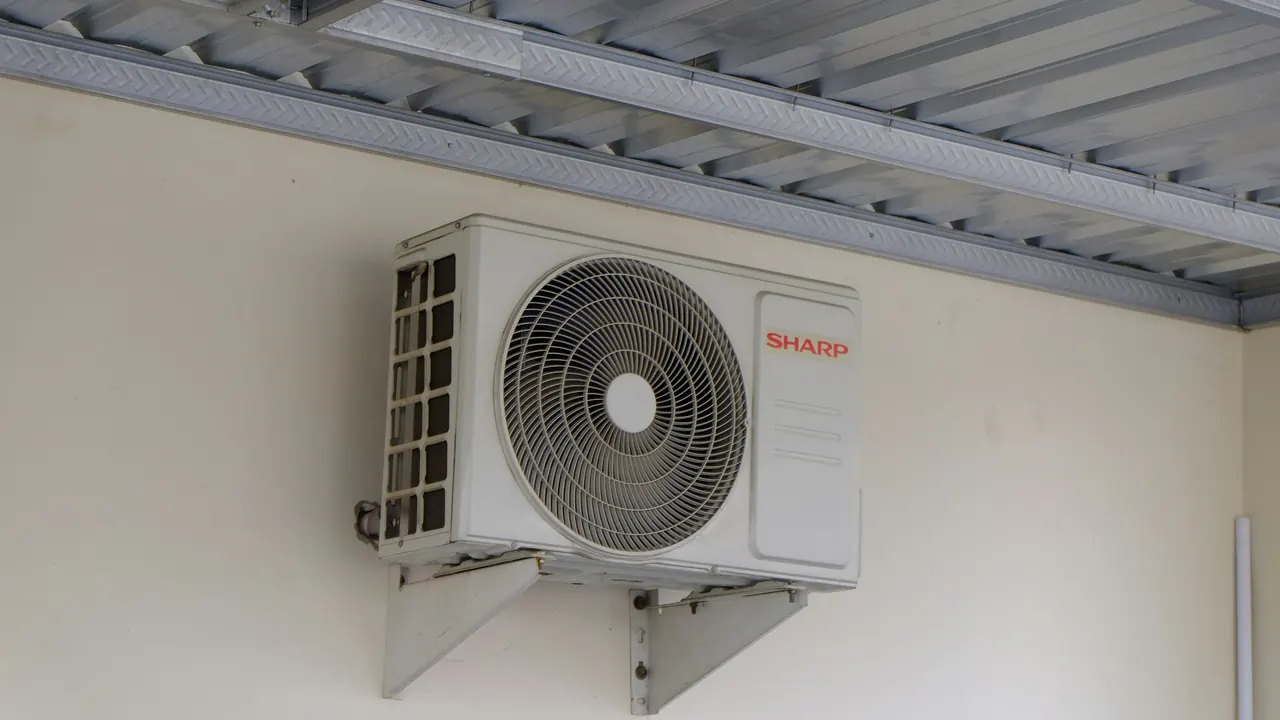
The right AC for a South Florida home is the one sized to that house's actual cooling load, not the biggest unit that fits the budget. A contractor should run a Manual J load calculation, select equipment from it, and confirm the system meets the federal minimum for Florida. For split-system air conditioners under 45,000 Btu/h installed in Florida, that minimum is 14.3 SEER2.
Why sizing matters more in a humid climate
An air conditioner does two jobs: it lowers air temperature and it removes moisture. In Miami-Dade, the moisture job is just as important as the temperature job, and the central AC is usually the only dehumidifier in the house.
An oversized unit cools the air to the thermostat setting quickly and shuts off. According to the U.S. Department of Energy (DOE) Building America guidance, that short run time leaves little time to pull moisture out of the air. Water that did condense on the coil can also evaporate back into the house when the fan keeps running after the compressor stops. The result is a house that feels cool but clammy.
Short cycling (frequent starts and stops) also adds wear to the compressor and can leave temperatures uneven from room to room. The U.S. EPA advises keeping indoor relative humidity below 60 percent, and ideally between 30 and 50 percent, to limit mold and dust mites.
"Bigger is better" has been tested in Florida
Oversizing is a long-running problem here. A 1996 Florida Solar Energy Center survey of Florida contractors found that roughly a third used Manual J, about a quarter used square-footage estimates, and more than a third said they had at times oversized on purpose, often because customers wanted lower indoor temperatures. That paper is old, but it explains why rules of thumb persist. A DOE fact sheet prepared by the same center (2002) reported that, in one Florida study, units oversized by 50 percent or more used about 9 percent more cooling electricity, and drove about 13 percent higher summer peak demand.
Treat these as historical research, not as a guarantee for your house. The point is the direction of the effect: extra capacity does not buy extra comfort.
What a Manual J load calculation is
Manual J is the residential load calculation procedure published by the Air Conditioning Contractors of America (ACCA). It estimates how much heat the house gains on a design-hot day so that equipment can be matched to it. ACCA notes that building codes and most state and local jurisdictions require a load calculation done under Manual J.
In practice, the calculation uses details of your home, such as:
- Square footage, ceiling heights, and the number of floors.
- Window area, orientation, glass type, and shading.
- Wall, attic, and floor insulation, and roof color and type.
- Duct location and condition. Ducts in a hot attic add load.
- Air leakage of the house.
- Outdoor design temperatures for your location and a chosen indoor setpoint.
Manual J is paired with other ACCA procedures. DOE's guidance points to Manual S for choosing equipment from the calculated load, and Manual D for designing the ducts. DOE advises asking for the load and equipment-selection calculations before equipment is purchased, and notes that a first estimate based on a rule of thumb is likely to be oversized.
In Miami-Dade, the county's residential mechanical plan review checklist lists Florida Building Code requirements on equipment sizing and cooling systems among the items reviewed. Ask your contractor which calculation will be submitted with your permit and request a copy.
Federal efficiency minimums that apply in Florida
DOE sets minimum efficiency by region. Florida is in the Southeast region. Since January 1, 2023, SEER2 (Seasonal Energy Efficiency Ratio 2) is the metric, measured under an updated test procedure. DOE says SEER2 ratings are similar to the old SEER ratings but not directly comparable, so do not subtract or convert numbers yourself.
| Equipment (Southeast region) | Minimum |
|---|---|
| Split-system air conditioner, under 45,000 Btu/h | 14.3 SEER2 |
| Split-system air conditioner, 45,000 Btu/h and above | 13.8 SEER2 |
| Split-system heat pump | 14.3 SEER2 and 7.5 HSPF2 |
| Single-package air conditioner | 13.4 SEER2 |
| Single-package heat pump | 13.4 SEER2 and 6.7 HSPF2 |
Two details matter for homeowners:
- Installation date controls. For Southeast split-system air conditioners, what counts is when the unit is installed, meaning when the refrigerant lines or electrical connections make it operational, not when it was manufactured. DOE states there are no delays or special exemptions from that rule.
- You do not have to replace a working system. The standards apply to equipment being installed, not to systems already in place.
Heat pumps are covered by the nationwide standard (shown in the table), and the regional split applies to air conditioners. If you are replacing only the outdoor unit, DOE says it can be paired with an existing indoor coil only if that combination is certified, and in the Southeast it must also meet the regional standard. Ask your contractor to show the AHRI certificate for the exact combination being installed.
Beyond the minimum: what to compare
A higher SEER2 rating lowers the energy needed per unit of cooling, but it is only one factor. For a South Florida home, compare:
- Humidity control features. DOE's guidance recommends a variable-speed air handler, which can run at lower airflow and let more moisture condense on the coil.
- Duct condition. The EPA advises fixing major air leaks and duct problems before or alongside a new system. A new unit connected to leaky attic ducts will not perform as rated.
- Installation quality. Correct refrigerant charge and airflow affect both comfort and efficiency. DOE guidance also suggests asking for AHRI certificates and proof of correct charge.
- Corrosion resistance if you are near the coast. See AC maintenance in humid, salty South Florida.
- Refrigerant. Newer equipment uses lower-global-warming refrigerants. See the refrigerant transition explained.
Compare quotes on the same basis: the same load calculation, the same capacity, and the same scope (indoor coil, line set, drain, electrical, permit).
Incentives: check before you buy
Do not assume an incentive exists. The federal Energy Efficient Home Improvement Credit applied to qualifying property placed in service before December 31, 2025, according to the IRS, so it is not available for new installations in 2026 on that basis. Local utility programs change. For example, Florida Power & Light published program standards effective September 1, 2025 describing a $200 per-unit rebate through participating contractors for qualifying systems, with its own equipment and replacement rules. Confirm with your utility whether it is still offered, and confirm any tax treatment with a tax professional.
Questions people ask
Is bigger better for Florida heat?
No. Extra capacity shortens run times, which can leave the house humid and add wear. The goal is a system sized to the calculated load, ideally with features that help it dehumidify.
How many square feet does one ton cover?
There is no reliable answer. The 1996 Florida survey found contractors using ratios across a wide range, from 350 to 700 square feet per ton. A home's glass, insulation, ducts, and leakage change the load, which is why a calculation is used instead.
What SEER2 do I need in Miami?
Federal minimums are 14.3 SEER2 for split-system air conditioners under 45,000 Btu/h installed in Florida. Higher-rated models are available, and the added cost should be weighed against the added savings and your plans for the house.
Does a new AC need a permit?
Yes, mechanical work generally requires one. See AC permits and licensing in Miami-Dade.
Check before you decide
- Ask for the Manual J load calculation and the equipment selection that follows from it.
- Confirm the AHRI certificate matches the exact indoor and outdoor combination and meets the Southeast standard.
- Ask how the design handles humidity and duct condition.
- Get the permit scope, the warranty terms, and the refrigerant type in writing.
- Confirm the contractor's license on the state DBPR site before signing.
Related: HVAC services.