
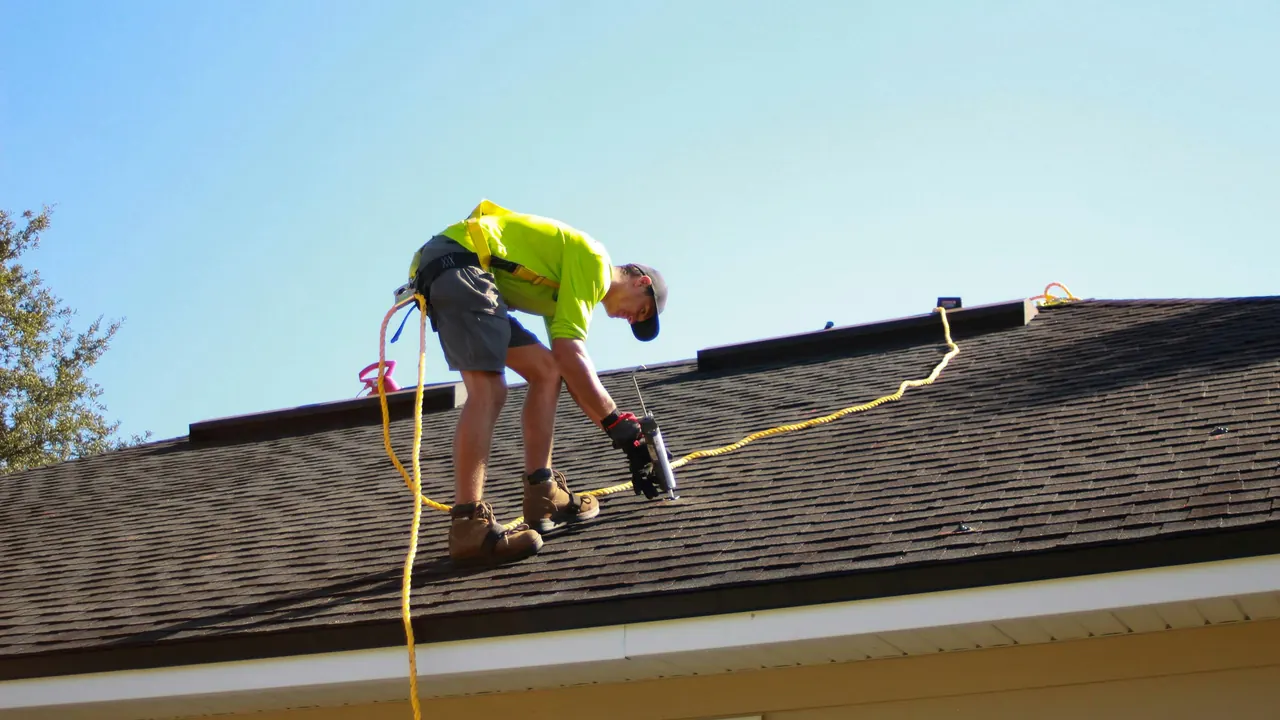
After a hurricane, put safety first, then photograph the damage from the ground, call your insurer, and stop further water entry with a temporary cover. Hire a permanent roofer only after you verify the Florida license on the DBPR website, get a written itemized estimate, and avoid anyone who pressures you to sign on the spot or asks for a large payment up front.
This is general information, not insurance or legal advice. Policies differ, so read yours and talk to your insurer.
Step 1: Stay safe
- Do not climb a damaged roof. OSHA's hurricane guidance says each damaged roof must be inspected before repair, wet surfaces and tarps are slippery, and weakened sections can fail underfoot. Start with binoculars or a phone camera from the ground.
- Assume downed lines are live. OSHA advises staying at least 10 feet from overhead power lines and not touching anything that may be energized, including fences, pipes and trees touching a line.
- Check the ceilings. Sagging or bulging ceilings may be holding water. Stay out of rooms below a heavily damaged roof.
- Generators. Never run one indoors or connect it to your house wiring without a transfer switch installed by a qualified electrician.
- Ladders. If someone must go up, use a ladder in good condition, set at a safe angle, extended well above the edge, and non-conductive near lines.
Step 2: Document the damage
Florida's Insurance Consumer Advocate recommends taking photos or video of the damage and keeping receipts for emergency repairs. In practice:
- Photograph the roof from every side of the house, then the interior damage.
- Take wide shots and close-ups, and note the date and time.
- Photograph damaged items before discarding anything unsafe.
- Keep all receipts and a log of calls with your insurer.
- Write down when you discovered each problem.
Step 3: Report the claim
The Insurance Consumer Advocate advises reporting damage to your agent or insurer immediately, knowing the date of loss, and checking your declarations page for your hurricane deductible. Its help line is 1-877-693-5236. Questions about coverage belong with your insurer, a licensed public adjuster or an attorney, not with a roofing salesperson. Florida's section 489.147 bars contractors who are not licensed public adjusters from interpreting your policy or adjusting your claim for you.
Step 4: Make temporary repairs
The Consumer Advocate advises making emergency repairs to prevent further damage and keeping records, including receipts and photos, of that work. Common temporary measures are:
- A tarp or temporary sheeting secured over the damaged area
- Covering openings to keep rain out
- Moving valuables and removing wet materials where it is safe
DBPR has said in past storm-season guidance that placing tarps on roofs does not require a state license, while roof repairs and installations do. One South Florida city's recovery guide likewise says temporary tarping does not need a permit but roof replacements and substantial roof repairs do. Rules vary, so ask your building department. Because wet tarps are slippery and a poorly placed tarp can blow off or cause more harm, this is often work for experienced crews.
Step 5: Verify a Florida roofing contractor license
Florida's Department of Business and Professional Regulation (DBPR) says roof repairs and installations require a state license.
- Ask for the contractor's name, business name and license number.
- Go to MyFloridaLicense.com and search by name or license number. DBPR also offers a mobile app.
- Check that the license is a roofing license. DBPR's code prefixes show certified roofing contractors with "CC" and registered (locally licensed) roofing contractors with "RC." Certified contractors may work statewide; registered contractors only in the jurisdictions where they registered. General contractors have other prefixes.
- Confirm the name on the license matches the person and company on your contract.
- In Miami-Dade, the county's online roofing permit system requires contractors to keep their license and insurance on file with the county's Contractors Section, so ask whether the contractor is registered there.
- Ask for proof of liability insurance and workers' compensation coverage.
DBPR also lists the Disaster Contractors Network (DCNOnline.org), a clearinghouse for searching Florida-licensed contractors by county after storms.
Step 6: Red flags of storm chasers
DBPR and the Consumer Advocate describe patterns that appear after storms. Be cautious if a contractor:
- Knocks on your door uninvited, or is out of state without a Florida license
- Pressures you to sign the same day
- Asks for cash, a large deposit or full payment up front. Florida law has timing rules when a deposit exceeds 10 percent of the contract price: permits applied for within 30 days and work started within 90 days after permits issue, unless just cause or written agreement.
- Offers to waive, absorb or "cover" your deductible, or offers rebates or gifts for an inspection. Section 489.147 prohibits these inducements.
- Says no permit is needed
- Will not give a written, itemized estimate or contract
- Asks you to sign blank forms or documents you have not read
Florida's section 489.147 also gives you cancellation rights. If you sign a roof contract within 180 days after an event covered by a governor's state-of-emergency declaration, and your property is in the declared area, you may cancel without penalty within 10 days of signing or the official start date, whichever is first. Cancellation has to be sent by certified mail or another method that proves delivery. Summary only: read the statute or ask an attorney.
To report suspected unlicensed activity, DBPR lists the Unlicensed Activity Hotline at 866-532-1440.
Step 7: Permit reminders
A roof replacement in Miami-Dade needs a building permit, a Miami-Dade NOA for roofing products, and inspections. A permitted job leaves records that matter later for insurance and resale. DBPR warns that skipped permits can make a home hard or impossible to sell. Ask who will pull the permit and get the permit number before work starts. See roof permit requirements in Miami-Dade.
Florida law allows some homeowners to repair or replace shingles on certain residences after a governor's emergency declaration without a contractor license. The conditions are narrow, including owner or tenant performing the work and the property not being offered for sale within a year, so confirm them before relying on this.
Questions people ask
Should I get my roof inspected even if I see no leaks?
If you suspect damage, a licensed roofer can inspect safely and document what is found. Small problems like lifted shingles or loose flashing let water in later.
Can I just use whoever shows up first?
Verify the license, check the contract and ask for references. Speed is not a substitute.
Should I repair or replace?
See repair or replace a roof in Florida. The answer depends on how much is damaged and the roof's permit history.
Can I measure my roof for estimates?
The roof measurement tool provides an area figure you can share with roofers. It does not show prices.
Check before you decide
- Photos, video and receipts saved in one place
- Insurer notified, claim number recorded
- License verified on DBPR and matched to the contract
- Written itemized estimate, with product and permit details
- Permit pulled before permanent work begins
- No payment beyond what the contract allows
For help with cost items, see what drives roof replacement cost in Miami-Dade. Laws change; confirm current rules.