
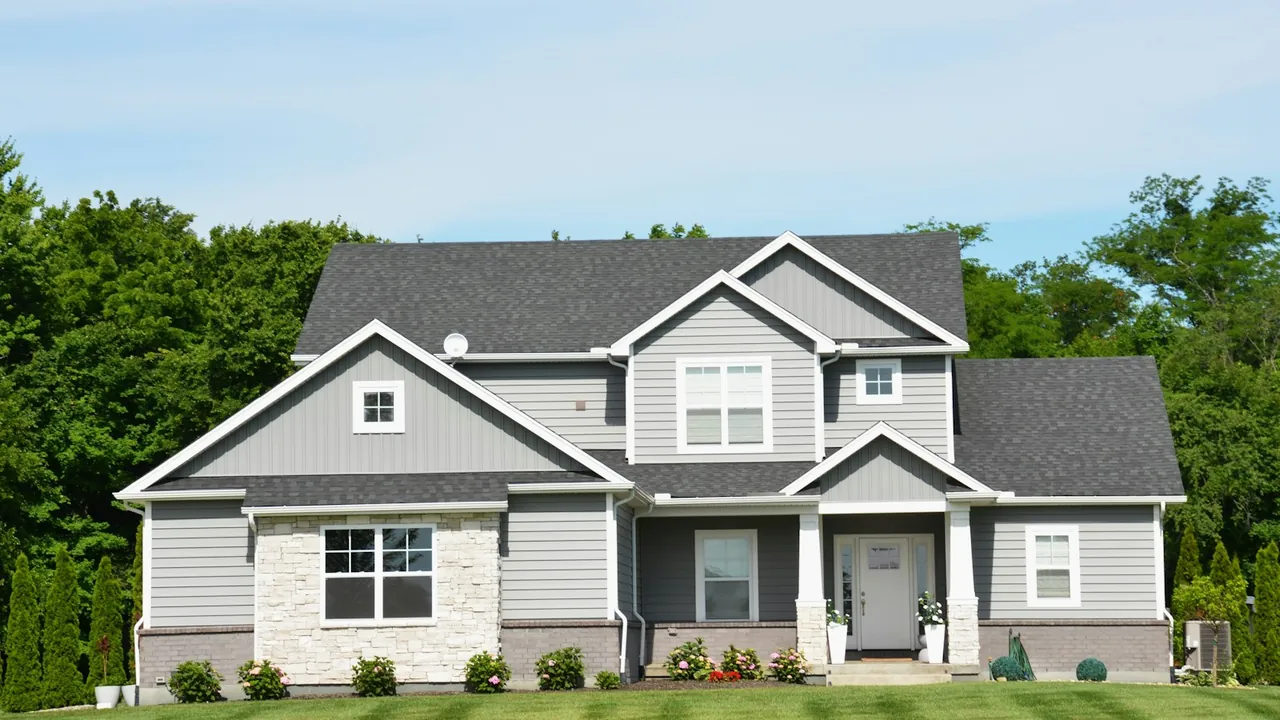
A shingle roof is more than the field shingles you see across each slope. Two sets of small parts finish it. Starter strips go along the bottom edge, where the first course starts. Hip and ridge shingles cover the lines where slopes meet at the top and at the corners. They are sold as separate products, and in a Florida product approval they are listed separately, each with its own wind classification and nailing rule. This article uses Owens Corning data sheets (viewed 2026-11-04) to show what those parts are, how to read their numbers, and what to ask in a proposal. AV Construction Group works with Owens Corning products, and the manufacturer is one of its material suppliers. The figures are the manufacturer's published data, not a promise of how a roof will behave in a storm.
What a starter strip does
The starter is the first row of material at the eave, under the first course of shingles. Its job is generally to give that first course something to bond to, and to cover the gaps between the tabs or cutouts of the first shingles. The manufacturer sells it as its own product.
Owens Corning's data shows two forms.
- Starter Strip Plus is a shingle-type strip of 15 1/2 by 39 3/8 inches. Each shingle splits into 2 pieces, and a bundle holds 16 shingles, which is 32 pieces and about 105 linear feet. The sheet says it is for shingles with an exposure of up to 6 inches and cites ASTM D3161 Class F and ICC-ES AC438.
- Starter Shingle Roll is a roll of 7.2 inches by 33 feet 4 inches, one per box.
The arithmetic checks out. A 39 3/8-inch shingle is about 3.3 feet, and 32 pieces of that length make roughly 105 feet. A quote should count linear feet of eave, and it should say how many bundles of starter that means. The same goes for the roll: a 33-foot-4-inch roll covers a bit over 33 feet of eave, so the roll count, like the bundle count, comes from the measured length of edge, not from the roof's area.
What hip and ridge shingles do
Hip and ridge shingles cover the peak and the angled corners of a roof. They are sized to bend over the line, which is why they are not the same size as field shingles. The sheets list these examples.
| Product | Piece size | Exposure | Pieces and length per carton | Other data on the sheet |
|---|---|---|---|---|
| DuraRidge | 12 x 10 5/8 in | 8 in | 30 pieces, 20 linear ft per box | Color-matched to Duration and Oakridge; built with SureNail for a 130 mph wind warranty |
| ImpactRidge (for Duration FLEX) | 12 x 12 in | Not listed here | 66 pieces (22 shingles per bundle), 33 linear ft per box | Wind up to 130 mph |
| ProEdge | See sheet | See sheet | See sheet | Color-matched to Duration and Oakridge |
| Berkshire | 12 x 10 5/8 in | See sheet | 30 pieces, 20 linear ft per box | None listed here |
Again the numbers can be checked. DuraRidge's 30 pieces at an 8-inch exposure give 240 inches, which is 20 feet. ImpactRidge's 33 feet from 66 pieces works out to 6 inches per piece. A proposal should state how many linear feet of ridge and hip the roof has and how many boxes that needs, and ask whether the ridge product is matched to the shingle line chosen.
Why they are listed separately in Florida
The Florida Building Commission lists an evaluation report for Owens Corning shingles, FL10674-R19. It is a non-HVHZ report, so it is not for use in Broward or Miami-Dade, but it shows how approvals treat these parts.
- Starters have their own table. Starter Strip Shingle, Starter Strip Plus and SRS TopShield Starter are listed with a wind classification of ASTM D3161 Class F, apart from the field shingles.
- Hip and ridge shingles have their own table. Berkshire and DuraRidge hip and ridge shingles with sealant, and ProEdge, are listed with ASTM D3161 Class F as well.
- Nailing is part of the listing. The report calls for at least five nails per strip for the starter products and at least two nails per shingle for Berkshire and DuraRidge, and says installation follows the manufacturer's current instructions.
The report gives each part its own classification and its own installation rule. So the right question is not whether the shingle has a wind rating, but whether every part has the approval and installation the permit lists.
In Miami-Dade and Broward
In the High-Velocity Hurricane Zone, the approval is a Miami-Dade Notice of Acceptance (NOA). NOA 26-0331.12 covers the Duration family of field shingles. It requires that shingles and flashing be installed under Roofing Application Standard RAS 115, and that exposure, course layout and nailing follow the details attached to the NOA. The scope of that NOA is the field shingles, so ask for the NOA number that covers the starter and the hip and ridge product named in your proposal. Florida product approval and NOA explained shows how to read one, and how to read a shingle spec sheet covers the field shingles.
Where the small parts sit in the whole roof
Starters and ridge caps work together with the underlayment, the drip edge, the flashing and the ventilation. A ridge shingle can be installed over a ridge vent, so the two products must suit each other. For that, see roof ventilation numbers and flashing and penetrations. For the layer under it all, see the secondary water barrier.
Questions people ask
Can a roofer just cut regular shingles for the starter?
The manufacturer sells starters as separate products, and the Florida evaluation report lists them by name. If a proposal says it will use cut shingles, ask which approval and which manufacturer instruction allow that, and get the answer in writing.
Do ridge caps have to match the shingle?
The sheets list color-matched ridge products for specific lines, such as DuraRidge for Duration and Oakridge. Matching may also matter for the approval and the warranty conditions, so ask which ridge product the permit and the warranty name.
Are starter strips used on the sides of the roof too?
Instructions differ by product and roof. Ask the roofer which edges get a starter and read the manufacturer's current installation instructions for the product.
Is a ridge cap a vent?
No. A ridge shingle covers the ridge line. A ridge vent is a separate product that lets air out, and the ridge shingles go over it.
Check before you decide
- Ask which starter product and which hip and ridge product are in the proposal.
- Ask how many linear feet of eave, hip and ridge the quote counts.
- In Miami-Dade or Broward, ask for the NOA number that covers each part.
- Ask how many nails per piece the instructions call for, and whether the crew follows them.
- Confirm the ridge product suits the ridge vent, if there is one.
- Read the warranty for conditions about the products used.
- Ask your roofing contractor to point to each part in the permit documents.
AV Construction Group works with Owens Corning products and counts the manufacturer among its material suppliers. If you would like a roof quoted with these materials, you can request a roofing estimate from AV, read about our roofing services or contact us.
The figures come from published manufacturer data sheets and public approvals. This article is general information, not engineering advice, and codes and approvals change, so verify details with your building department.